Authored by Lee Kapnisi, CFA, CFP®, CPWA®, Senior Financial Planner and Jason Doyle, Co-Director of Research | Mason Investment Advisory Services, Inc.
Few events generate more market attention than a major company going public. An IPO, or initial public offering, is the process by which a private company sells shares to the public for the first time, shifting price discovery from private negotiations to the open market. A founder rings a bell, a valuation headline runs across every financial outlet, and for a brief window the stock becomes the story everyone is trying to get in on. 2026 has offered no shortage of examples. SpaceX, SK Hynix, and soon possibly OpenAI and Anthropic have turned initial public offerings into some of the most closely watched events in the market this year.
What tends to get far less attention is what happens after the debut. The first trading day is a headline. The next one, three, five, and ten years are where an investment either proves itself or does not. Before deciding whether you should invest in an IPO, it is worth understanding what the historical pattern looks like once the cameras leave, and why so many investors get pulled in without asking that question first.
IPOs in 2026: A Year Unlike Any Other
OpenAI, Anthropic, and SpaceX have collectively targeted approximately $3.8 trillion in combined market capitalization upon listing, a scale of offering the market has not seen before. OpenAI confidentially filed for an IPO in June 2026, initially targeting a listing as early as the third or fourth quarter of 2026, though it is reportedly weighing a delay into 2027 following a volatile debut from SpaceX. Anthropic filed confidentially a week earlier, on June 1, 2026, and is reportedly still tracking toward a late-2026 debut.
Not every major listing this year followed the same script. SK Hynix raised $26.5 billion in its U.S. listing in July 2026, the largest-ever U.S. debut by a foreign company, surpassing Alibaba’s 2014 offering. Unlike a young, unproven company entering the market for the first time, SK Hynix arrived with tripling revenue and an operating history dating back to 1983. That distinction matters more than most headlines let on, and it is the first thread worth pulling on before evaluating any IPO: is this a company proving a new idea, or a known business simply changing where its shares trade?
It is also worth understanding that an IPO is not the only door into public markets. A direct listing is another path companies use to go public, typically by allowing existing shareholders to sell shares directly, and it is more common among large, consumer-facing companies because it carries lower administrative costs than a traditional IPO. The distinction matters for investors because the two paths create different early trading dynamics and different levels of price discovery in the first days after listing.
What History Shows About Stock Price After the IPO Debut
The period immediately following an IPO tends to be the most volatile stretch in a stock’s public life, and a few widely covered examples help illustrate why patience, or the lack of it, tends to matter more than most investors expect going in.
Uber (2019)
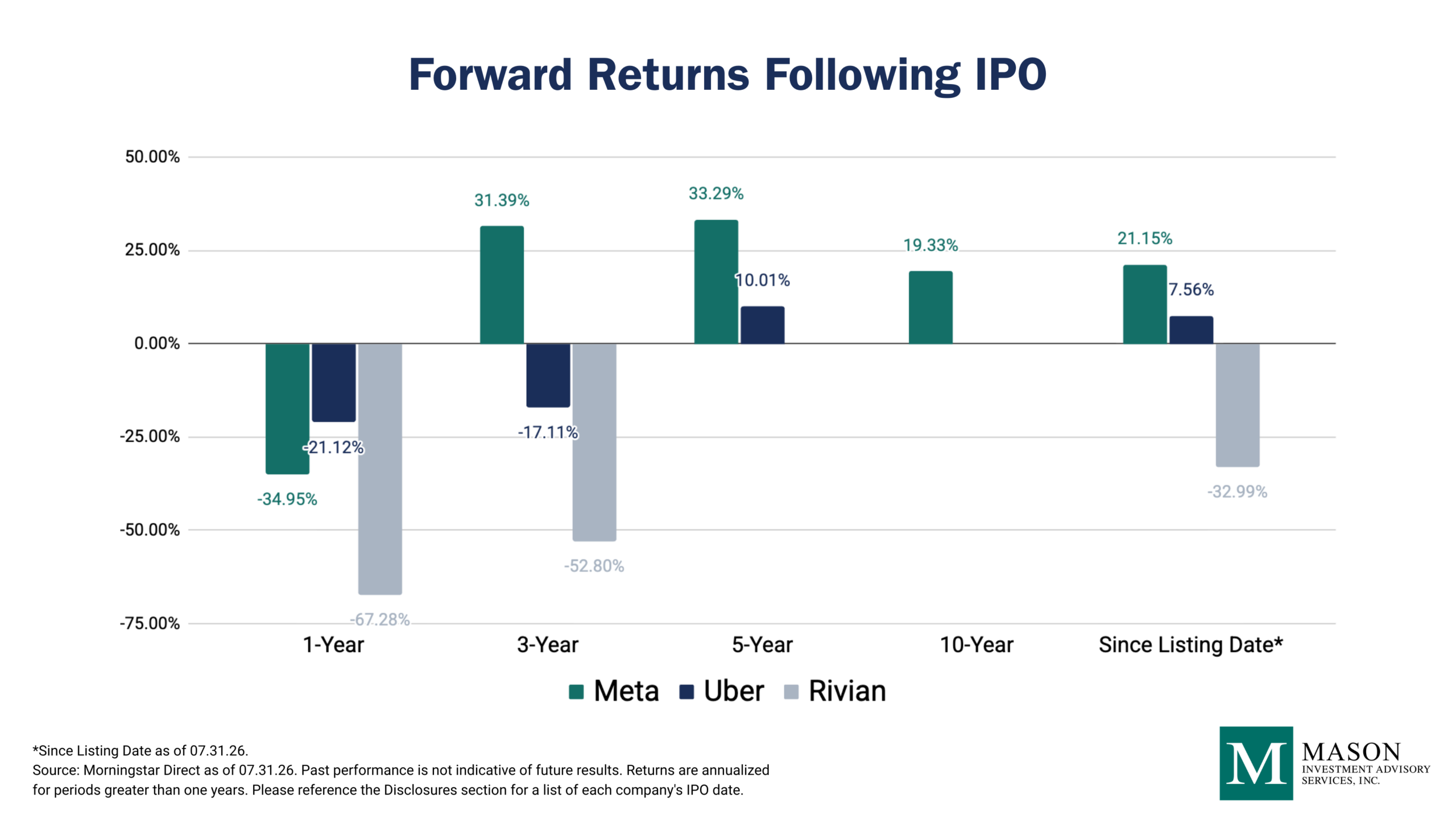
Uber priced its IPO at $45.00 per share in May 2019. The stock closed its first trading day at $41.57, which at the time represented the biggest first-day dollar loss in U.S. IPO history. Throughout the remainder of 2019, the stock stayed volatile, ranging between highs near $45 and lows near $26, before closing the year at $29.74. As of early August 2026, Uber’s stock closed at $71.61, roughly 59 percent above its IPO price nearly seven years later, though still about 28 percent below the all-time high of $100.10 it set in October 2025. An investor who bought at the offering and held did eventually see a gain, but only after years of drawdowns along the way that would have tested most people’s conviction, and only if they were still holding the stock by the time the recovery arrived.
Rivian (2021)
Rivian priced its IPO at $78 per share in November 2021, raising $11.9 billion at a roughly $66.5 billion valuation, with pricing that came in above its initial target range of $72 to $74. Within a week, shares had climbed to $172, a 120 percent increase from the offering price. The excitement did not hold. As of mid-2026, Rivian’s stock trades roughly 87 percent below its IPO price, and the company’s outstanding share count has also grown by roughly 38 percent since going public, meaning a share purchased at the IPO represents a smaller slice of ownership today than it did in 2021. Rivian is a useful reminder that early enthusiasm and long-term value are two different things, and the market frequently confuses one for the other in the first weeks of trading. The comparisons drawn at the time to a much larger, established EV maker were a story about what Rivian might become, not evidence of what it had already proven.
SpaceX (2026)
A more recent listing shows how compressed this volatility can be. SpaceX priced its IPO at $135 per share on June 12, 2026, and shares rose as high as $193 on the first day of trading, a 19 percent gain. Within weeks, the stock had fallen nearly 50 percent from the record high above $225 set days after the IPO. By early August 2026, shares were trading below the original offering price, closing as low as $104.83 before recently rebounding to $138.74 (value on 8/11/2026). One structural feature is worth understanding: SpaceX floated less than 5 percent of its total shares at the IPO, concentrating heavy demand into a very small supply of stock, and additional shares typically become available as employee and early-investor lockup periods expire.
Where the stock goes from here is unknown, and nothing here is intended as a view on SpaceX as an investment. The point is narrower: a widely admired company can still see its shares move this dramatically in the first weeks of trading, which is precisely the window in which most individual investors are deciding whether to buy.
Uber and Rivian are not outliers. They are close to the norm. Looking across the largest IPOs in U.S. market history, a pattern emerges.
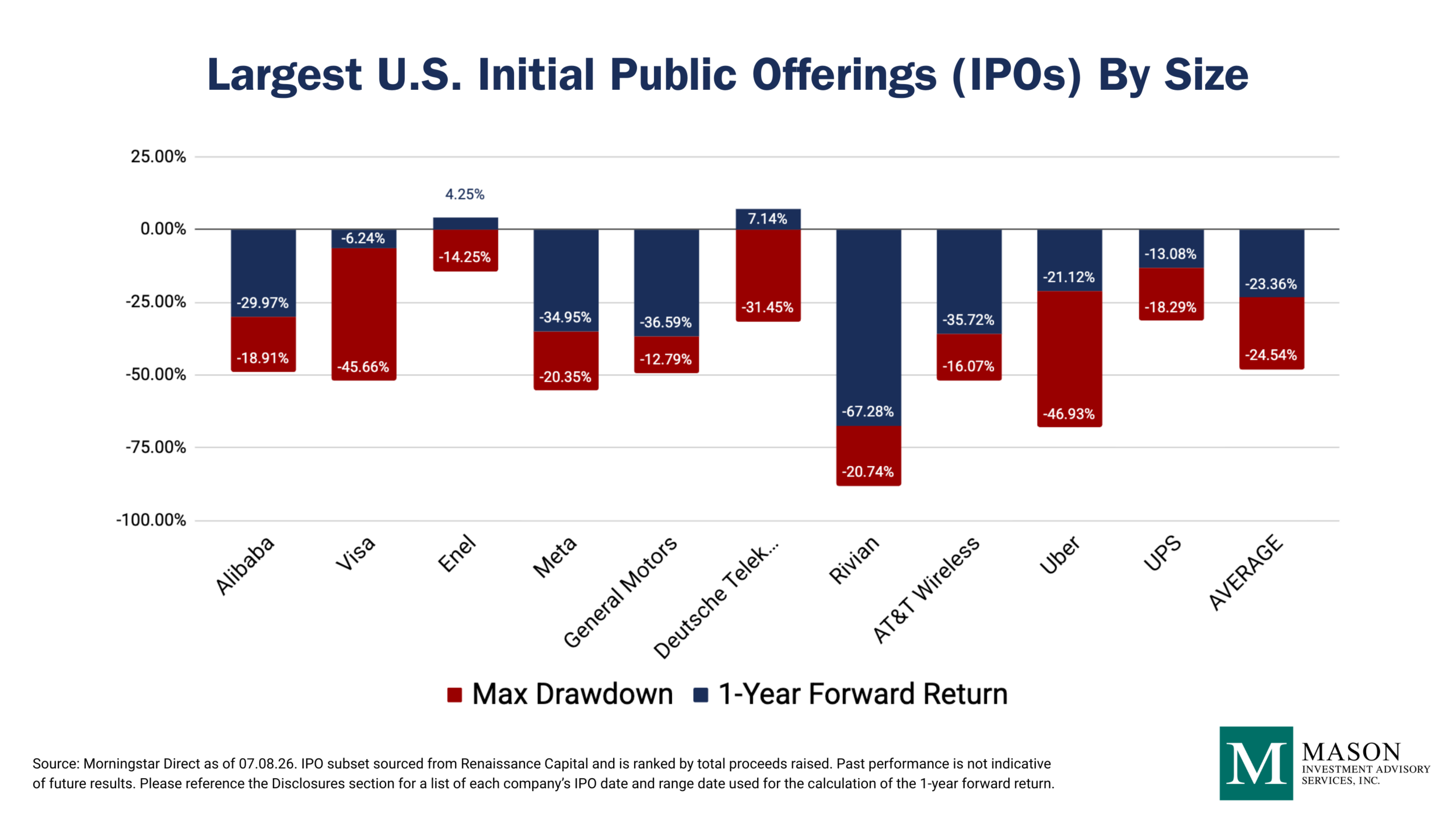
Across eleven of the largest U.S. IPOs on record, including Alibaba, Visa, Meta, General Motors, and UPS, the average stock delivered a 1-year forward return of -23.4 percent and an average maximum drawdown of -47.9 percent. Only two of the eleven, Enel and Deutsche Telekom, posted a positive 1-year forward return. Source: Morningstar Direct, as of July 8, 2026. IPO subset sourced from Renaissance Capital, ranked by total proceeds raised. Past performance is not indicative of future results.
If the data skews this negative this consistently, the obvious question is why investors keep buying in anyway. The answer has less to do with financial analysis than with human behavior.
Why the Hype Is So Hard to Resist
None of this means IPO enthusiasm is irrational. It is human, and understanding why it happens is as important as understanding the price history. Media coverage of an IPO focuses on the excitement of the debut, not the years of trading that follow it. That creates a few predictable pulls on investor behavior:
- Fear of missing out (FOMO) turns a headline valuation and a well-known founder into something that feels inevitable rather than optional. When a company like SpaceX or OpenAI dominates the news cycle for weeks, not participating can start to feel like a mistake, regardless of whether the valuation makes sense.
- Access to information. Retail investors are also working with far less information than the institutions setting the offering price. Assigning a fair value to a private company requires financial detail that only a small number of institutional investors have access to before the stock ever trades publicly. That gap in information is easy to underestimate in the moment.
- Influential personalities. The personalities involved matter more than most investors would like to admit. A charismatic founder or a widely followed public figure can make an offering feel like a referendum on that person rather than a straightforward evaluation of a business.
- Vision vs. reality. Compelling narratives can also feel like evidence. The comparisons drawn between Rivian and an established, dominant EV maker at the time of its IPO are a good example: a story about what a company could become, mistaken for proof of what it already was.
And once a stock is public, investors tend to measure its success against the IPO price alone, rather than against the fundamentals as they evolve. A stock trading below its offering price is not automatically a bad investment, and one trading above it is not automatically a good one. The offering price is a historical reference point, not a verdict.
Recognizing which of these is driving a decision, the fundamentals or the crowd, is often the difference between a plan and a bet.
A Framework for How to Evaluate an IPO Before Investing
Setting the hype aside, a disciplined way to evaluate any IPO includes a few consistent steps.
Start with capacity and risk tolerance before looking at the company at all.
Most investors should limit a single IPO stock to about 1 to 5 percent or less of their total assets, and for many households the right allocation is closer to zero. The more useful questions are how much of this position could be lost without disrupting a near-term goal such as retirement or a home purchase, and whether a 50 percent decline could be held through without an emotional decision to sell at the bottom. A diversified portfolio moves through market cycles as a whole. A single IPO position creates the same kind of exposure as a concentrated stock position: an outcome tied to one company’s execution, one industry’s fortunes, and one management team’s decisions, rather than the broader market.
Understand how access works.
It is typically institutional investors who buy IPO shares at the offering price, though individual investors can sometimes participate if they have an account through a brokerage firm involved in the offering, and eligibility and share allocation are not guaranteed even then. Most individual investors instead purchase shares once trading begins on the open market, at whatever price the first day establishes, which, as the examples above show, can already be well above or below the original offering price by the time an order fills.
Read past the headline and into the fundamentals.
The preliminary prospectus, or S-1, provides information about the company’s business operations, financials, management, and risk factors, and revenue growth, cash flow, profit margins, and debt levels help clarify a company’s financial health and long-term growth potential. It is also worth understanding how the offering proceeds will be used, whether to fund growth, pay down debt, or allow early investors and employees to cash out, and how the valuation compares to public peers already trading in the same space.
Decide on timing deliberately rather than by default.
Waiting until after the IPO allows an investor to observe price and volume behavior following the debut, though it may mean missing early gains if the stock performs well immediately. There is no universally correct answer, only a correct one for a specific portfolio and time horizon.
Plan for the tax consequences before, not after, a sale.
If shares are acquired early and appreciate quickly, the length of the holding period materially affects how any gain is taxed. This is a conversation worth having with an advisor while a position is still being built, not after a decision to sell has already been made.
Consider whether it belongs in a retirement portfolio at all.
Time horizon matters more here than almost anywhere else in a financial plan. An investor several decades from retirement has more room to hold through the kind of volatility described throughout this piece than someone already withdrawing from their portfolio. This is a decision best made in the context of a full retirement plan, not in isolation from it.
Frequently Asked Questions
Should I invest in an IPO?
It depends on your time horizon, risk tolerance, and how the position would fit within your broader portfolio. Most investors should limit a single IPO stock to about 1 to 5 percent or less of their total assets, and for some investors the right allocation is closer to zero. This is a decision best made with a financial advisor who understands your full financial picture, not in response to market headlines alone.
What is an IPO and how does it work?
An IPO is the process by which a private company sells shares to the public for the first time, typically with the help of underwriters who set an initial offering price. Once trading begins, that price is determined by the open market rather than private negotiation.
Is it risky to invest in an IPO?
Yes. IPO companies typically have a limited public track record, and offerings often carry valuations that can later prove difficult to sustain. This does not make every IPO a poor investment, but it does mean the risk profile is different from an established, seasoned public company.
Why do IPO stocks often drop after the first year?
Newly public companies often lack a long track record in public markets, which can lead to overvaluation at the offering that later corrects as the market absorbs more information about the business. As the chart above shows, this pattern holds across most large IPOs, not just a handful of well-known cases.
How much of my portfolio should be in one stock?
This depends on the specific stock and how it was acquired, but as a general guide, most investors should limit a single stock position, IPO or otherwise, to about 1 to 5 percent or less of their total assets. A concentrated stock position, however it was built, ties a meaningful portion of an investor’s outcome to a single company rather than the broader market.
Can I lose money in an IPO even if the company is well known?
Yes. Recognition is not the same as valuation. Uber and Rivian were both widely known at the time of their offerings, and both experienced significant declines afterward. A familiar brand does not guarantee a favorable entry price.
Do IPO stocks always recover if they drop?
Not necessarily, and the timeline varies widely. Uber took roughly six years to trade meaningfully above its offering price. Rivian, by contrast, remained roughly 87 percent below its IPO price five years after going public, with no guaranteed recovery timeline. An investor should be prepared for either outcome, not just the favorable one.
Should I buy at the IPO price or wait until after the stock starts trading?
Waiting allows an investor to observe price and volume behavior after the debut, though it may mean missing early gains if the stock performs well immediately. The right approach depends on individual risk tolerance and the role the investment would play in the broader portfolio.
Is IPO investing appropriate for a retirement portfolio?
It depends on time horizon and capacity for loss. An investor several decades from retirement has more room to hold through the volatility discussed above than someone withdrawing from their portfolio in the near term. This is a decision best made in the context of a full retirement plan, not in isolation.
What is happening with the OpenAI and Anthropic IPOs?
Both companies filed confidentially for a public listing in June 2026 and were initially targeting a debut later in the year, though timing for both remains fluid and is being closely watched following SpaceX’s volatile post-IPO trading.
Talk to a Mason Advisor Before You Decide
IPOs generate a lot of headlines, but very little of that coverage accounts for an individual investor’s timeline, tax situation, or overall portfolio. Whether a specific offering has caught your attention or you are simply weighing whether IPO investing belongs in your plan at all, a Mason private client advisor can walk through the fundamentals together and help determine what, if anything, makes sense given your broader financial picture.
Click here to schedule a conversation with a Mason Investment Advisory Services advisor to talk through your questions.
Lee Kapnisi, CFA, CFP®, CPWA®, is a Senior Financial Planner at Mason, which he joined in August 2022. He was awarded the CFA charter in 2019 and earned his CERTIFIED FINANCIAL PLANNER™ certification in 2015. Prior to Mason, Lee served as a Senior Wealth Management Advisor at TIAA in Fairfax, Virginia. He holds a Masters of Mechanical Engineering from Exeter University in the UK.
Jason Doyle is Associate Consultant and Co-Director of Research at Mason, where he analyzes market data and performance trends to support the firm’s investment insights. He joined Mason in September 2022 following 15 years at Cambridge Associates, where he served as a Senior Investment Analyst for several of the firm’s highest revenue generating client relationships, including endowments.
Disclosures
The views, opinions and content presented are for informational purposes only and reflect the current opinion of the writers as of 08.13.26. Opinions and forward-looking statements expressed are subject to change without notice. The content presented does not constitute investment advice, should not be used as the basis for any investment decision, and does not purport to provide any legal, tax or accounting advice. Information is based on data gathered from what we believe are reliable sources. It is not guaranteed as to accuracy, does not purport to be complete and is not intended to be used as a primary basis for investment decisions. It should also not be construed as advice meeting the particular investment needs of any investor.
Past performance is not indicative of future results. All investing is subject to risk, including the possible loss of the money you invest. There is no guarantee that any particular asset allocation or mix of funds will meet your investment objectives or provide you with a given level of income. Diversification does not ensure a profit or protect against a loss.
Services are offered through Mason Investment Advisory Services, Inc. (“Mason”) an independent investment adviser registered with the U.S. Securities and Exchange Commission. Registration does not imply a certain level of skill or training. More information about Mason, including our investment strategies, fees, and objectives, is included in the Form ADV Part 2, which is available upon request. This is not an offer or solicitation for investment advisory services.
IPO History
| Company | IPO Date | 1-Year Forward Return Date Range |
| Alibaba | 09.18.2014 | 09.19.2014 – 09.29.2015 |
| Visa | 03.18.2008 | 03.19.2008 – 03.19.2009 |
| Enel | 11.01.1999 | 11.02.1999 – 11.02.2000 |
| Meta | 05.17.2012 | 05.18.2012 – 05.18.2013 |
| General Motors | 11.17.2010 | 11.18.2010 – 11.18.2011 |
| Deutsche Telekom | 11.17.1996 | 11.18.1996 – 11.18.1997 |
| Rivian | 11.09.2021 | 11.10.2021 – 11.10.2022 |
| AT&T Wireless | 04.26.2000 | 04.27.2000 – 04.27.2001 |
| Uber | 05.09.2019 | 05.10.2019 – 05.10.2020 |
| UPS | 11.09.1999 | 11.10.1999 – 11.10.2000 |