By Eric Rife, CFP®, CPWA® and Thomas Pudner, CPA, CFA, CFP®, MST Co-Chief Investment Officer and Co-Director of Research, Mason Investment Advisory Services
We often come across investors who have accumulated substantial holdings in a single company. A corporate executive paid in stock options and other forms of equity who is required to hold a multiple of their salary in company stock. An employee who purchased company stock a long time ago and has been fortunate enough to see it increase in value by many multiples of the initial investment.
In both cases, a specific stock position has come to represent a significant — sometimes majority — share of an investor’s overall portfolio. When this happens, the overweighting can expose the portfolio to heightened volatility and company-specific risks that a well-diversified portfolio would not carry. Diversifying this concentration is essential to achieve a balanced portfolio and to mitigate the potential for catastrophic losses.
There are several strategies to effectively manage a concentrated stock position, each with its own benefits and trade-offs. Before evaluating which approach fits best, it helps to start with foundational questions:
- What is the purpose of this stock?
- Is it for retirement income?
- Will it be used for charitable gifting?
- Is it meant to help fund legacy goals?
- What is your expectation of future performance for this stock relative to a broadly diversified portfolio of equities?
- If you did not own any of this stock today, how much would you purchase?
The answers to these questions shape which strategy, or combination of strategies, makes the most sense for your specific situation. Below, we walk through six primary approaches, the tax implications of each, and the circumstances in which each is most appropriate.
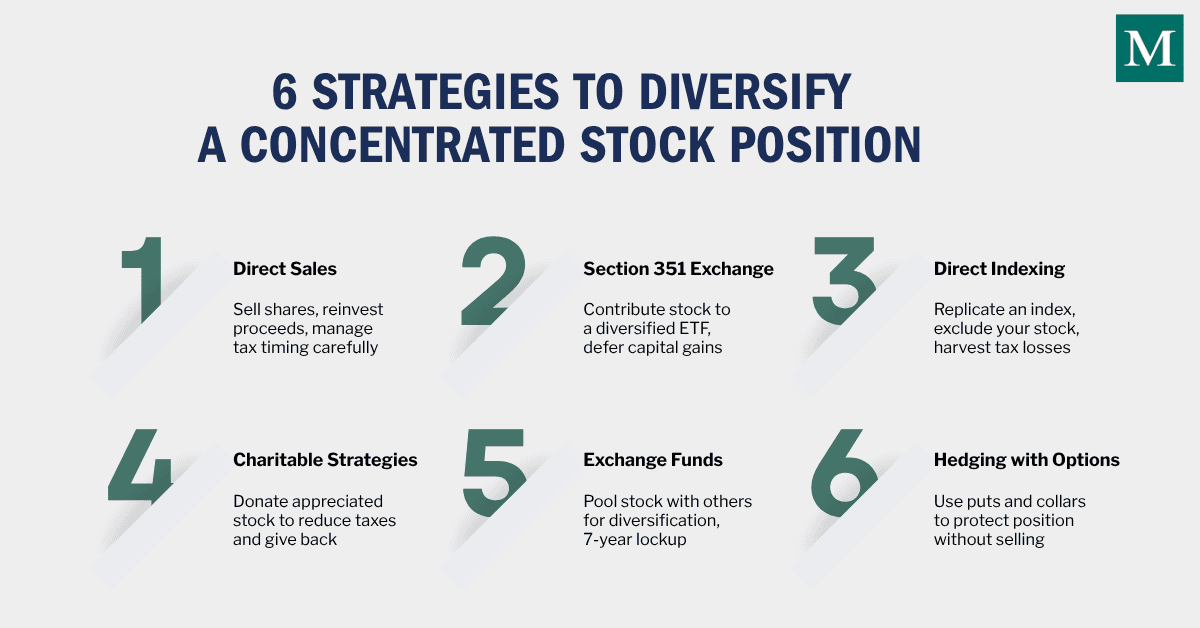
1. Direct Sales
The most straightforward approach to diversifying a concentrated stock position is to sell shares and reinvest the proceeds. Selling the position creates immediate liquidity for purchases of other securities that may contribute to a more balanced portfolio that can serve as a hedge against downside risk.
But direct sales create tax liabilities that can be onerous. Depending on how long the position has been held and the size of the gain, a sale can trigger a significant federal and state capital gains tax bill and may require adjustments to quarterly estimated tax payments or your overall tax bill at year end.
To mitigate the tax impact, investors may opt for a gradual liquidation strategy, selling portions of the position over time. An analysis can help determine tax ramifications and whether it is optimal to sell over months or spread sales over one or more years.
When implementing a sales strategy, it is also important to use a seasoned trader to ensure best execution. These so-called block traders are specialists in trading large blocks of stock without causing market disruptions that may negatively impact sales pricing.
For an executive working for a public company, it may be advisable to set up a 10b5-1 plan before liquidating any shares. A 10b5-1 plan allows corporate executives to set a prearranged trading schedule during a trading window, based on predetermined price triggers or dates. These plans, when implemented properly, can provide an affirmative defense against allegations of insider trading, but they require a loss of flexibility and control in selecting when or how many shares to sell.
2. Section 351 Exchange into a Diversified ETF
For investors who want to diversify a concentrated position without immediately recognizing taxable capital gains, a Section 351 Exchange offers a compelling alternative to an outright sale.
Through a Section 351 Exchange, investors contribute a basket of stocks, ETFs, or cash in exchange for shares of a diversified ETF. Unlike an exchange fund, a Section 351 Exchange is a one-time event, after which the investor holds shares of a diversified ETF that can be traded like any other ETF. The tax basis in the new ETF equals that of the shares contributed, providing participants with tax-deferred treatment on unrealized gains.
To qualify for tax-deferred treatment, the basket of stocks contributed must pass a diversification test: no single stock may exceed 25% of the total contribution, and the top five stocks used to fund the investment may not be greater than 50% of the total contribution.
The key distinctions from an exchange fund: there is no lock-up period, no requirement to include illiquid private real estate assets, and the resulting ETF can be traded at any time. For investors who have been deterred by the restrictions attached to exchange funds, the 351 Exchange deserves careful consideration.
For a comprehensive guide to the Section 351 Exchange, including worked examples and the diversification test in detail, read The Section 351 Exchange: The Tax-Smart Way to Diversify Company Stock Most Advisors Don’t Know About →
3. Direct Indexing
Direct indexing involves replicating the performance of an index by directly owning the individual securities within it. Portfolios can be tailored to exclude specific securities in the index, including the concentrated stock the investor already holds.
This approach allows shares of the concentrated stock to be traded over time for shares in stocks held in the broader index, providing added diversification and greater control over the taxation of sales. Tax loss harvesting of other holdings may help offset the tax impact of gradually selling shares of the concentrated position.
Direct indexing works particularly well for investors who want to maintain broad market exposure while systematically reducing concentration risk over time, without triggering a large taxable event in any single year. For a deeper look at how this strategy works, who tends to be a good fit, and how it compares to a Section 351 exchange, read our full breakdown: What Is Direct Indexing and Is It Right for Your Concentrated Stock Position?
4. Charitable Strategies
For investors with philanthropic goals, charitable strategies offer some of the most tax-efficient paths to diversification. There are three primary vehicles worth understanding.
Donor Advised Funds
Donor Advised Funds are charitable pools typically managed by a sponsoring organization. Executives can donate shares of concentrated stock to a DAF without incurring capital gains taxes. After the shares are transferred, the proceeds may be invested in a diversified portfolio. The donor receives a tax deduction for the full market value of the shares donated and benefits from realizing their philanthropic goals through the donation.
For investors who want to give generously and diversify at the same time, a Donor Advised Fund is often the most efficient tool available.
Charitable Remainder Trusts
Creating a Charitable Remainder Trust and donating concentrated stock to the trust can provide several benefits simultaneously. Charitable Remainder Trusts eliminate capital gains at the trust level, maximizing proceeds available for reinvestment. That gain may then be partially recognized over time by the beneficiary over the term of the trust. The donor also receives a tax deduction for the present value of the charitable gift — and benefits from income smoothing and tax deferral over the life of the trust.
Once the stock is in the trust, it can be sold and reinvested in a diversified portfolio, reducing risk. The CRT can also be structured to provide a steady income stream to the donor or other designated beneficiaries, making it particularly attractive for investors approaching retirement who need ongoing income alongside diversification.
Gifts of Shares to Friends or Family
If you are considering gifts to friends or family, gifting appreciated stock rather than cash can reduce overall taxes while achieving the desired gifting outcome. Although the person receiving the gift will pay tax on any gains if and when they sell, this can be beneficial if the recipient is in a lower tax bracket than the donor. For investors planning to give money to children, grandchildren, or other family members, appreciated stock is almost always the more tax-efficient choice.
Direct Gifts to a 501(c)(3) Charity
For investors who want to support a specific charitable organization directly, gifting appreciated stock to a qualified 501(c)(3) charity is a straightforward and highly tax-efficient option. As with a Donor Advised Fund, the donor avoids recognizing the capital gain on donated shares and receives a charitable deduction for the full fair market value of the stock at the time of the gift. The difference is that the funds go directly to the charitable organization rather than through an intermediary vehicle. This approach works best when the donor has a specific charity in mind and does not require the flexibility to direct grants over time that a Donor Advised Fund provides.
5. Exchange Funds
Exchange funds, sometimes referred to as swap funds, provide diversification of concentrated stock positions without immediate tax consequences. In this strategy, investors contribute their concentrated holdings to a pool of assets managed by a fund. In return, they receive shares in the fund, which represents a diversified portfolio of stocks or other assets.
In certain circumstances, exchange funds may be appealing for investors who face substantial capital gains taxes on direct sales. However, these funds often require a lock-up period of seven years to defer taxes and may impose high fees on both the initial contribution and ongoing management. The fund is not obligated to accept a contribution if it has already accepted many contributions of the same or similar stock. Often, the stocks received at the end of the seven-year period may not be as diversified as the investor might hope.
Exchange funds also carry a requirement to hold at least 20% of the fund in qualified assets. Typically, funds purchase illiquid private real estate assets to meet this requirement.
6. Hedging with Options
Not every executive who holds a concentrated position wants to sell or give it away. For investors who want to retain ownership of their stock while managing downside risk, derivative instruments such as options provide a flexible hedging approach.
Two strategies are commonly used in this context.
A protective put gives the investor the right to sell the stock at a specified price, creating a floor for potential losses while retaining upside participation. This effectively insures the position against significant downside moves without requiring a sale.
A collar combines a protective put with a covered call. The investor buys a put option and simultaneously sells a call option. The premium received from the call sale offsets some or all of the cost of the put, making it a low-cost or no-cost way to limit downside risk. The trade-off is that the collar also caps upside potential above the call strike price.
Both strategies carry costs and constraints that must be weighed carefully against the protection they provide. Certain executives subject to Section 16 reporting requirements may also be restricted from entering hedging strategies involving company stock and should confirm with their company’s legal department before proceeding.
Choosing the Right Strategy: What Mason Looks at First
Diversifying a concentrated stock position is a critical step in managing risk and achieving a more balanced portfolio. A thoughtful diversification strategy not only can help to preserve wealth but may also improve financial stability in the face of market uncertainties.
No single strategy is right for every investor. The best approach depends on a combination of factors: the size of the position and the embedded gain, the investor’s income and tax situation, their philanthropic intentions, their time horizon, and their need for liquidity.
At Mason, we work closely with corporate executives to choose the strategy that best suits their unique financial objectives, risk tolerance, tax situation, and life goals. In many cases, the most effective approach combines multiple strategies, deploying each tool in the context for which it is most suited.
One consideration that often shapes this decision is the broader retirement income picture. For executives approaching retirement, the question of how to diversify a concentrated position is inseparable from the question of how much they can sustainably withdraw once they do. Understanding both sides of that equation together is essential.
For more on how Mason thinks about retirement income planning for executives, read: Why Most Retirement Withdrawal Models Fall Short and What We Built Instead →
Frequently Asked Questions About Diversifying a Concentrated Stock Position
How do I diversify a concentrated stock position?
The six primary strategies for diversifying a concentrated stock position are direct sales, Section 351 Exchanges into a diversified ETF, direct indexing, charitable strategies (including Donor Advised Funds and Charitable Remainder Trusts), exchange funds, and hedging with options. The right strategy depends on the size of your position, your embedded gain, your tax situation, your philanthropic goals, and your time horizon. Most executives benefit from a combination of strategies rather than a single approach.
What are the tax implications of selling a concentrated stock position?
Selling a concentrated stock position typically triggers capital gains taxes on the difference between your cost basis and the sale price. For long-term holdings, this is taxed at long-term capital gains rates, which are more favorable than ordinary income rates but can still represent a substantial liability for large positions. Strategies such as gradual liquidation, 10b5-1 plans, charitable giving, and Section 351 Exchanges can reduce, defer, or in some cases eliminate this tax liability depending on the investor’s circumstances.
What is a 10b5-1 plan and how does it help executives sell company stock?
A 10b5-1 plan allows corporate executives to set up a prearranged trading schedule for selling company stock during a trading window, based on predetermined price triggers or dates. When implemented properly, these plans provide an affirmative defense against allegations of insider trading, allowing executives to sell shares systematically without the flexibility concerns that come with ad hoc sales.
Can I donate concentrated stock to avoid capital gains?
Yes. Donating appreciated stock directly to a Donor Advised Fund or a Charitable Remainder Trust allows you to avoid recognizing the capital gain on the donated shares. You also receive a charitable deduction for the full fair market value of the stock at the time of the gift. This makes charitable giving one of the most tax-efficient strategies for investors with philanthropic goals who also need to reduce a concentrated position.
What is the difference between an exchange fund and a Section 351 Exchange?
An exchange fund pools contributions from multiple investors into a diversified fund in exchange for shares, deferring capital gains but imposing a lock-up period of seven years and requiring a portion of the fund to be held in illiquid assets. A Section 351 Exchange is a one-time event in which an investor contributes a basket of stocks into a new diversified ETF, receiving ETF shares with a carried-over tax basis. Unlike an exchange fund, the resulting ETF can be traded at any time with no lock-up period and no requirement for illiquid assets.
What Should You Do If You Have a Concentrated Stock Position?
- The first step is to understand the full picture. That means knowing the size of your position, your cost basis, your current tax situation, your income needs, and your goals for the wealth this stock represents. Without that foundation, it is difficult to evaluate which strategy or combination of strategies makes the most sense.
- The second step is to resist the instinct to do nothing. Concentration risk is real, and the longer a portfolio remains overexposed to a single stock, the more vulnerable it becomes to outcomes that no amount of planning can reverse after the fact. The investors most hurt by concentrated positions are almost always the ones who waited.
- The third step is to work with an advisor who has genuine experience with these strategies. Not all advisors regularly navigate 10b5-1 plans, Section 351 Exchanges, or Charitable Remainder Trusts. The complexity of these tools, particularly their tax implications, requires both investment expertise and planning depth working together.
At Mason, we work with corporate executives at exactly this intersection. If you are holding a concentrated position and are not sure where to start, the right first move is a conversation. Click here to schedule a consultation with a Mason advisor >>
Eric Rife, CFP®, CPWA®, is a Financial Planner at Mason Investment Advisory Services specializing in concentrated equity positions and executive compensation planning.
Thomas Pudner, CPA, CFA, CFP®, MST, is Co-Chief Investment Officer and Co-Director of Research at Mason Investment Advisory Services, where he has led investment research and portfolio strategy for 20 years.
This communication is for informational purposes and should not be considered as investment advice or a recommendation of any particular security, strategy or investment product. Opinions and forward-looking statements expressed are subject to change without notice. Services are offered through Mason Investment Advisory Services, Inc. (“Mason”) an independent investment adviser registered with the U.S. Securities and Exchange Commission. Registration does not imply a certain level of skill or training. More information about Mason, including our investment strategies, fees, and objectives, is included in the Form ADV Part 2, which is available upon request. This is not an offer or solicitation for investment advisory services. Investing involves risk, including possible loss of principal. Asset allocation and diversification may not protect against market risk, loss of principal or volatility of returns. There is no guarantee that any investment strategy discussed herein will work under all market conditions.
Direct indexing is viewed as a hybrid form of investing that combines elements of both passive and active management. Investors need to be willing to accept benchmark-like potential returns as a starting point, with any customization of the portfolio possibly leading to a higher level of tracking error, which may lead to significant deviations from the benchmark return and has the potential to increase portfolio risk.
Options involve additional risk to normal investments and are not suitable for all investors. Writing and buying options are speculative activities and entail investment exposures that are greater than their cost would suggest, meaning that a small investment in an option could have a substantial impact on performance.
Section 351 exchanges involve significant tax and investment risks that could result in substantial adverse consequences. The transaction’s complexity requires specialized professional guidance, as errors in structuring or documentation can result in complete disqualification of intended tax benefits, significant penalties, and substantial unexpected tax liabilities.
Exchange funds require a minimum holding of up to seven years, during which an investment will be illiquid and an investor may not be able to withdraw funds. While an exchange fund is designed to provide diversification benefits, there is no guarantee that diversification will be achieved.