


By Eric Rife, CFP®, CPWA®, Wealth Advisor
Equity compensation is often treated as a reward to hold onto rather than a decision to actively manage. RSUs, stock options, and other forms of company stock arrive on a schedule set by an employer, which can make it easy to let vesting and exercising happen passively, without a clear plan for what comes next. But every stage of the equity lifecycle, from grant to sale, carries its own tax and financial planning implications.
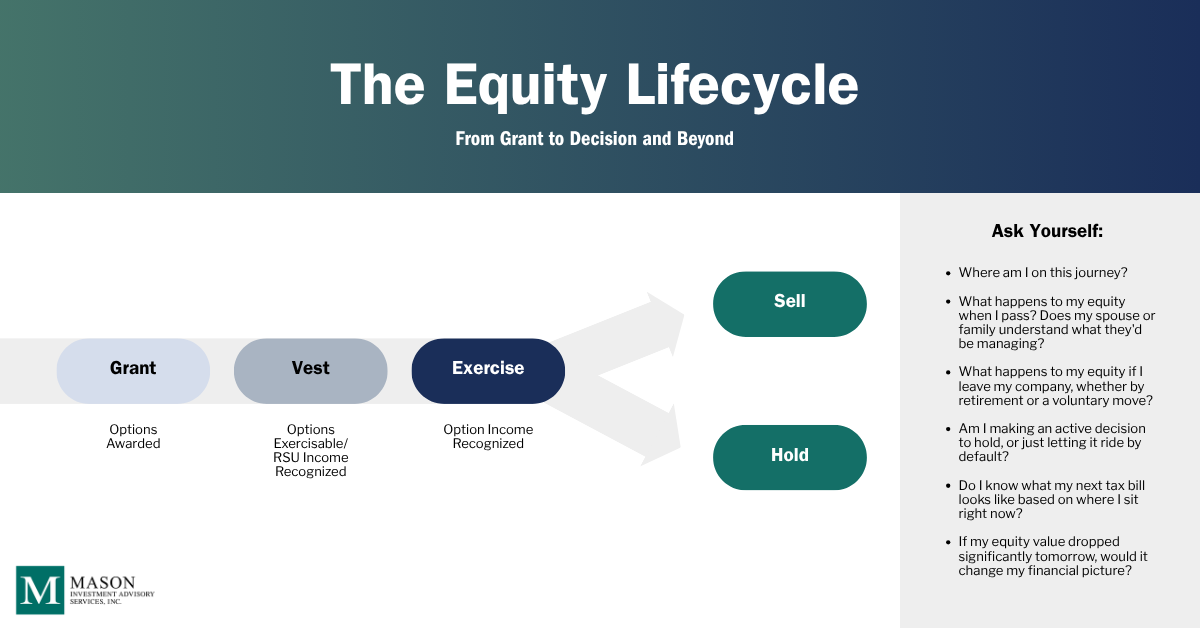
Before working through the mechanics, it helps to start with a few honest questions. Where does an individual’s equity currently sit in this lifecycle? Is holding a deliberate choice, or is it happening by default? Is there a clear picture of what the next tax bill will look like, and what would change financially if the stock’s value dropped significantly? These questions apply whether the equity in question is still unvested, sitting exercised in a brokerage account, or concentrated after years of accumulation.
Every Stage Is a Decision Point
Once options are exercised or RSUs vest, there are really only two paths forward: sell or hold. Neither is automatically the right answer, and each comes with tradeoffs worth naming explicitly.
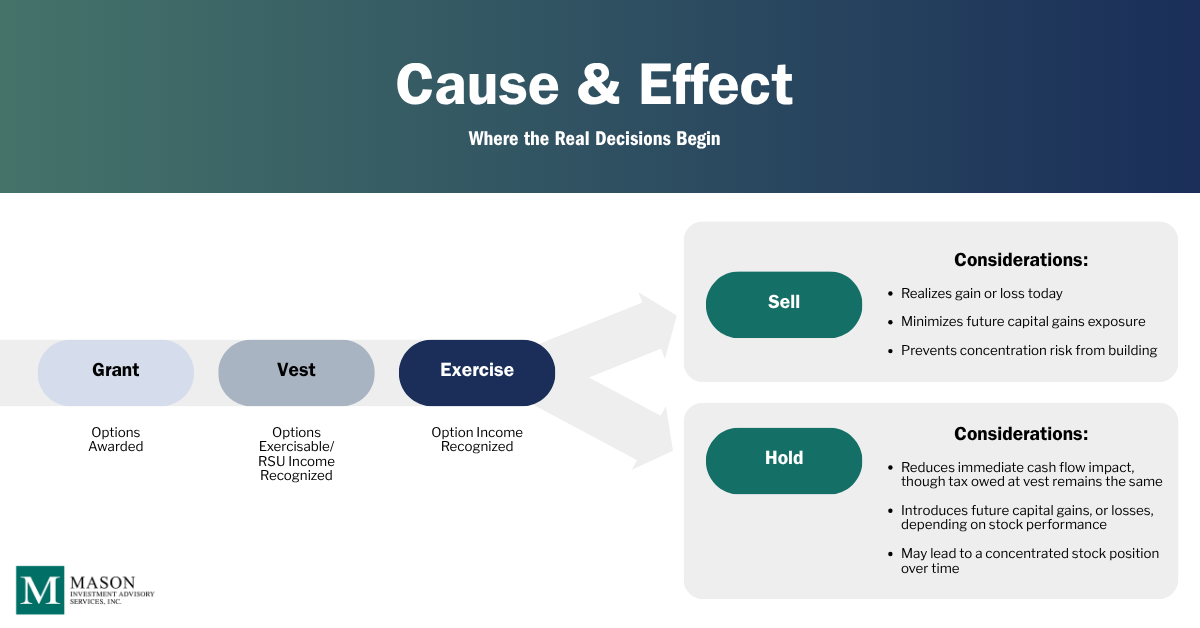
Upon an RSU vest or an option exercise, you have the opportunity to immediately sell your company stock. Doing so turns that stock into actual cash flow, limits future capital gains exposure, and prevents a concentrated position from building further. Holding reduces the immediate cash flow impact of a sale, though it’s worth noting that the tax owed at RSU vest or option exercise remains the same either way. Holding also introduces future capital gains or losses depending on how the stock performs, and over time it may lead to a concentrated position in a single company’s stock.
A Framework Built on Three Lenses
Rather than treating equity compensation as a single decision, it helps to break it into three separate lenses: income tax, cash flow, and concentration risk. Looking at all three together, rather than in isolation, tends to produce a clearer picture of the tradeoffs involved.
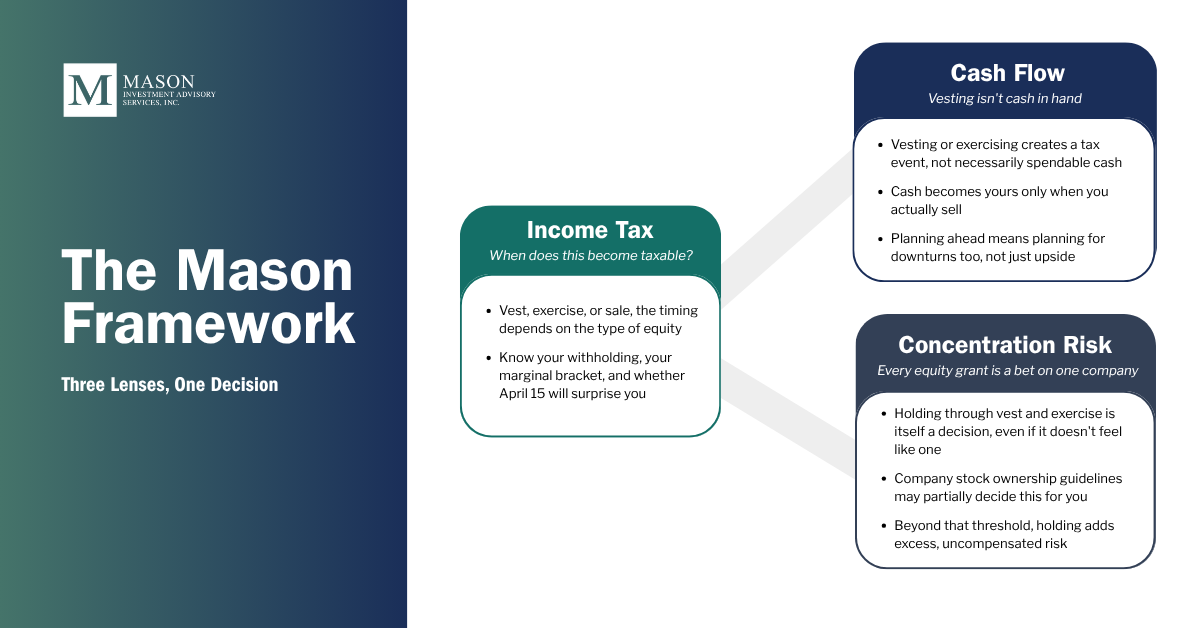
Income tax asks when a given piece of equity compensation becomes taxable. The timing depends on the type of equity compensation involved, whether it’s vesting, exercising, or a later sale, and it’s worth understanding withholding and marginal tax bracket well before April 15 arrives.
Cash flow is a reminder that vesting isn’t the same as cash in hand. An RSU vest or option exercise event creates a tax obligation, not necessarily spendable cash, and that cash only becomes available once shares are actually sold. Planning ahead means accounting for downturns as well as upside.
Concentration risk treats every equity grant as, functionally, a bet on one company. Holding through vest and exercise is itself a decision, even when it doesn’t feel like one. Many companies have stock ownership guidelines that partially dictate this outcome, but beyond that threshold, continuing to hold adds risk that may not be compensated by additional expected return.
Nonqualified Stock Options: Where Timing Meets Taxation
Nonqualified stock options (NSOs) move through a defined sequence: grant, vest, exercise, and eventually sale. The tax event occurs at exercise, when the spread between the strike price and current fair market value is recognized as ordinary income.
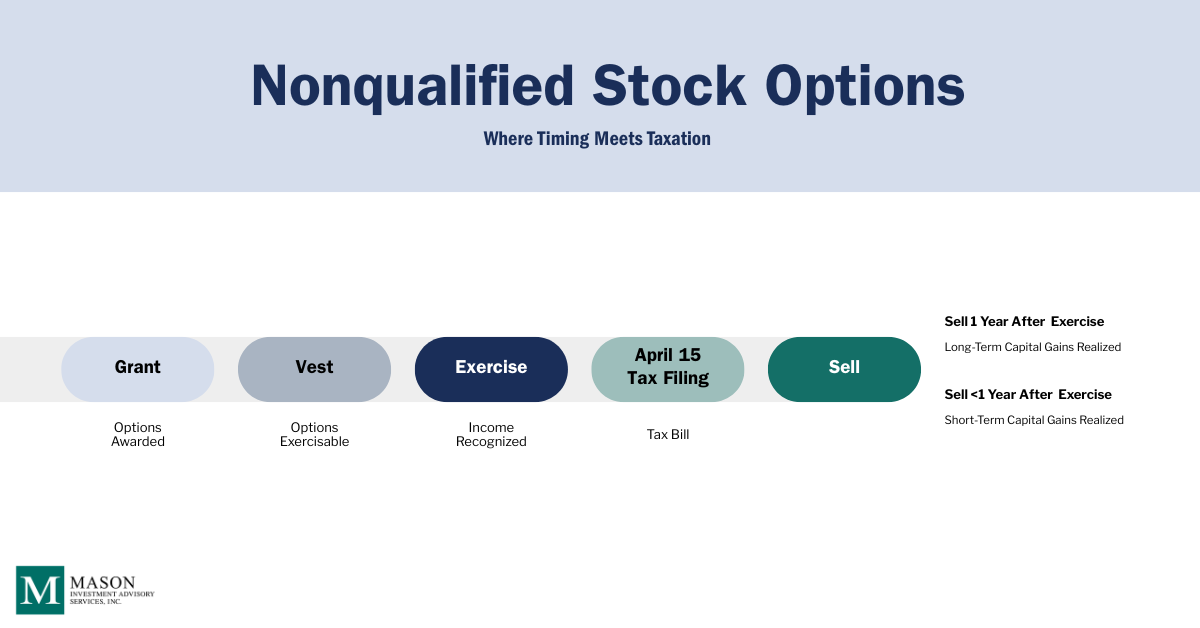
Whether a subsequent sale is taxed at long-term or short-term capital gains rates depends on how long the shares are held after exercise. Selling more than one year after exercise qualifies for long-term treatment, while selling within a year triggers short-term capital gains rates.
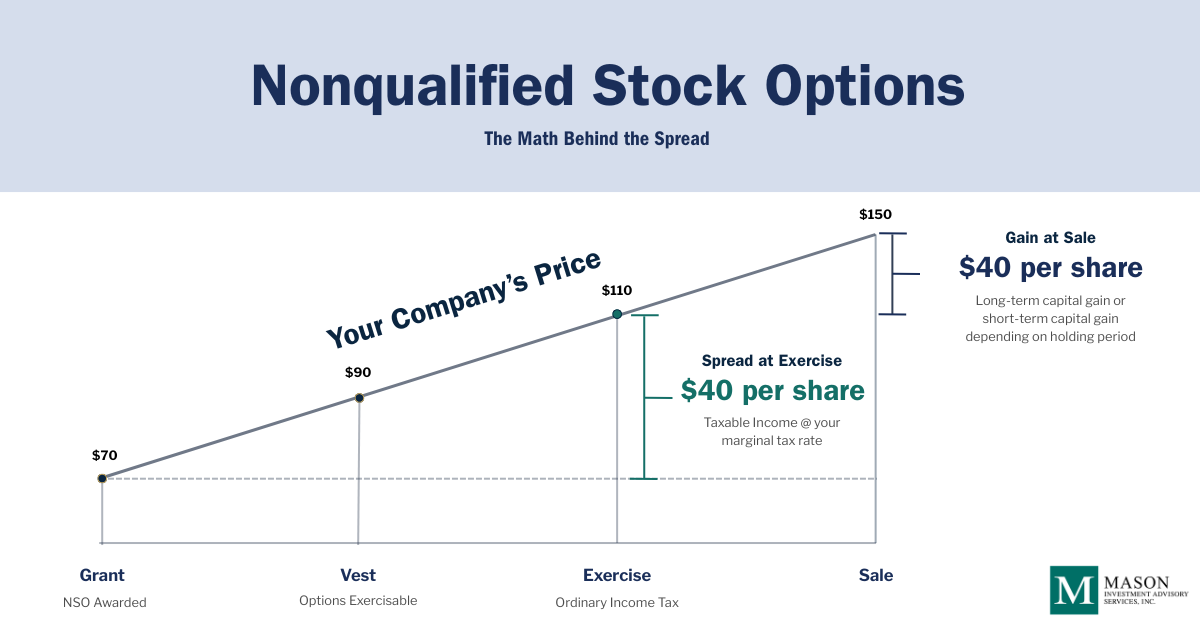
A simplified example illustrates the mechanics: if an option is granted when the stock trades at $70, vests as the stock reaches $90, and is exercised at $110, the $40-per-share spread at exercise is taxed as ordinary income at the individual’s marginal rate. If the stock is later sold at $150, the additional $40-per-share gain is taxed as a capital gain, long-term or short-term depending on the holding period.
Restricted Stock Units: A Different Tax Trigger
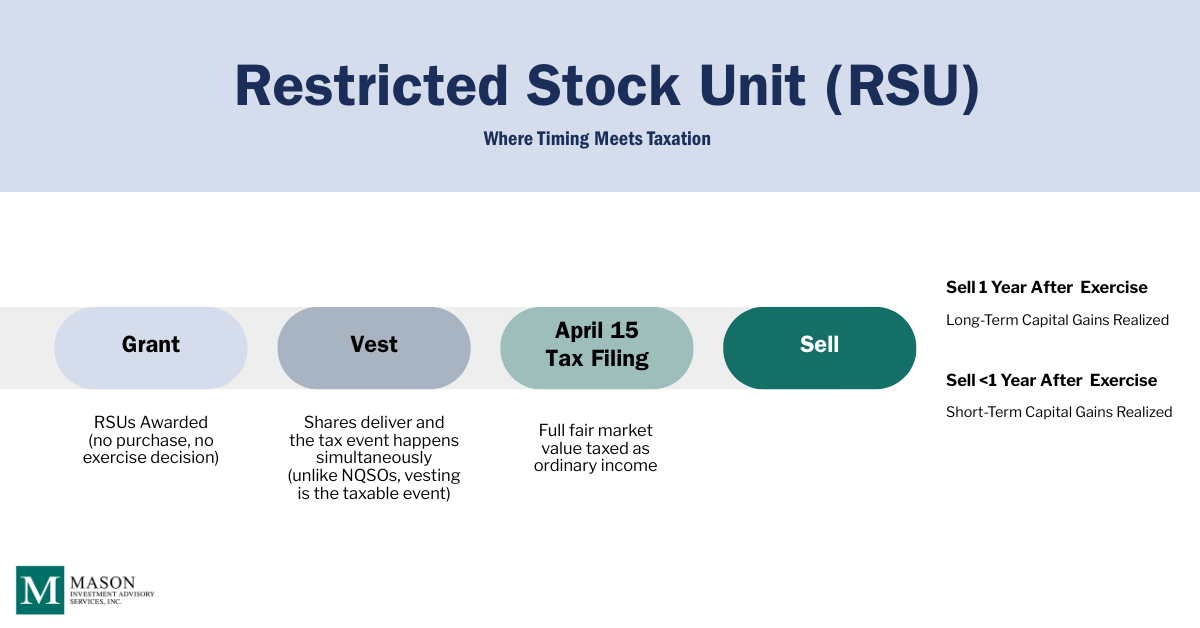
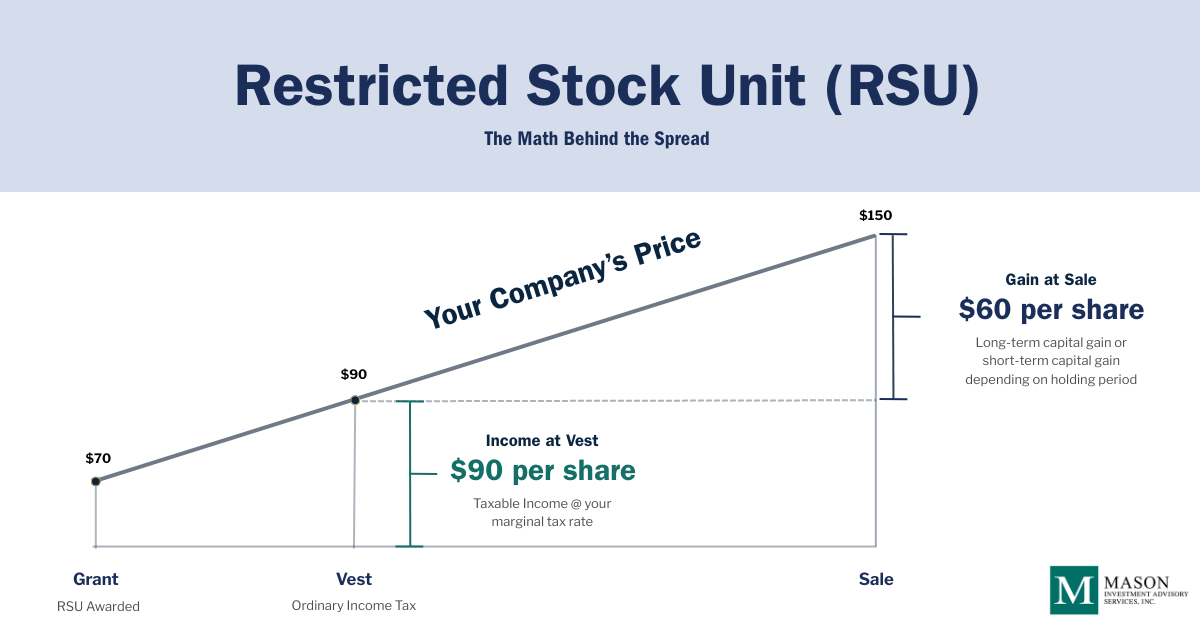
RSUs follow a simpler structure on paper, but the tax timing works differently than it does for options. There’s no purchase or exercise decision involved. Instead, the tax event happens the moment shares deliver at vesting, when the full fair market value of the shares is taxed as ordinary income.
Using the same example figures, an RSU granted at $70 and vesting at $90 recognizes $90 per share as ordinary income at vest, since the entire value delivered is taxed at that point, not just the appreciation. If those shares are later sold at $150, the $60-per-share gain from vest to sale is taxed as a capital gain, again subject to the long-term or short-term distinction based on holding period.
The Equity Tax Trap
RSUs, NSOs, commissions, and bonuses are all typically classified by the IRS as supplemental income, and supplemental income withholding doesn’t always track an individual’s actual marginal tax bracket.
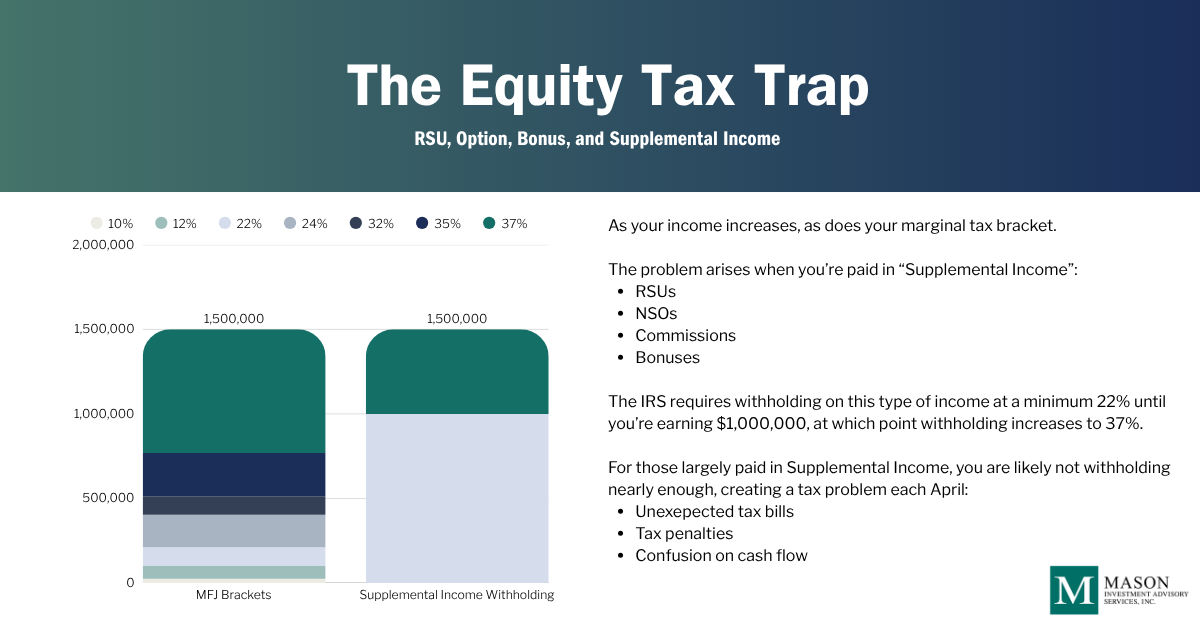
The IRS requires a minimum 22% withholding on supplemental income, increasing to 37% only once an individual’s earnings cross the $1,000,000 threshold. For someone whose income sits between those two points, and whose marginal bracket is well above 22%, this can create a meaningful gap between what’s withheld and what’s ultimately owed. That gap is often the source of unexpected tax bills, tax penalties, and general confusion about cash flow each April, particularly for those largely paid through supplemental income.
Six Strategies for a Concentrated Position
For those who have held equity long enough to build a concentrated position, several strategies exist to manage that risk without necessarily requiring an all-or-nothing decision.
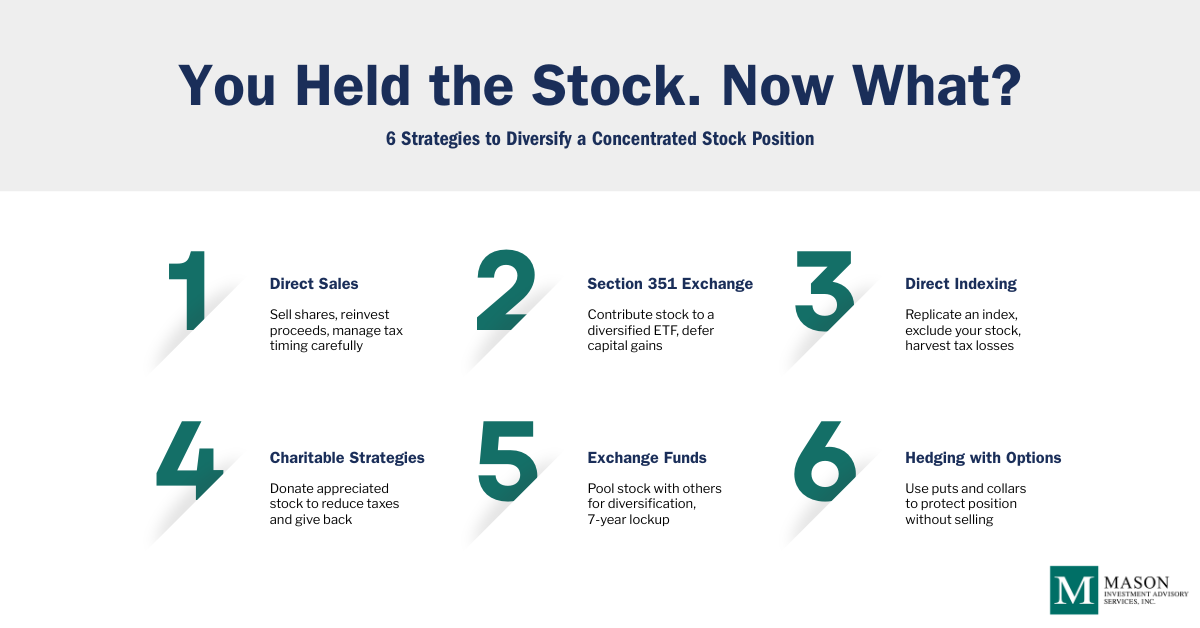
- Direct sales — selling shares and reinvesting proceeds, with tax timing managed carefully.
- Section 351 exchanges — contributing stock to a diversified fund structure while deferring capital gains.
- Direct indexing — replicating an index while excluding the concentrated position, with the ability to harvest tax losses along the way.
- Charitable strategies — donating appreciated stock, which can reduce taxes while supporting philanthropic goals.
- Exchange funds — pooling stock with other investors for diversification, generally subject to a holding period of up to seven years.
- Hedging with options — using puts and collars to manage downside exposure without selling the underlying position.
Each of these carries its own complexity and risk profile, and the disclosures below outline several of the considerations specific to direct indexing, options, Section 351 exchanges, and exchange funds.
Bringing the Three Lenses Back Together
Equity compensation decisions rarely come down to a single factor. Income tax timing, cash flow reality, and concentration risk all interact, and a decision that looks reasonable through one lens can look different once the other two are factored in. That’s the reason for approaching it as a framework rather than a single rule of thumb. Remember:
- Income Tax: When does this become taxable?
- Cash Flow: Vesting isn’t cash in hand
- Concentration Risk: Every equity grant is a bet on one company
How Mason Can Help
Mason works with individuals to review the full picture of their compensation, including base salary, cash bonus, 401(k) match, profit sharing, and RSUs or PSUs, nonqualified stock options and incentive stock options, and how each piece contributes to long-term financial planning. That includes helping determine whether company benefits are being fully utilized, advising on applicable elections, and helping manage both the timing of large cash payouts and the tax liabilities tied to them.
Conversations about equity compensation can start at any stage, whether shares have just been granted or a concentrated position has built up over years, and don’t require having every question answered in advance.
Eric Rife, CFP®, CPWA®, is a Financial Planner at Mason Investment Advisory Services specializing in concentrated equity positions and executive compensation planning.
Frequently Asked Questions
When do I owe taxes on my RSUs?
RSUs are taxed as ordinary income at the moment they vest, based on the full fair market value of the shares at that time. This differs from stock options, where the tax event occurs at exercise rather than at vesting.
Why is my company withholding less tax than I actually owe on my equity compensation?
RSUs, stock options, commissions, and bonuses are generally treated as supplemental income, which the IRS requires to be withheld at a minimum of 22% until earnings cross $1,000,000, after which withholding increases to 37%. For individuals in higher marginal tax brackets, this withholding often falls short of the actual amount owed.
What’s the difference between how NSOs and RSUs are taxed?
Nonqualified stock options are taxed at exercise, when the spread between the strike price and current fair market value is recognized as ordinary income. RSUs are taxed at vesting, when the full value of the delivered shares is recognized as ordinary income. Both types are later subject to capital gains treatment on any additional appreciation after that taxable event, depending on the holding period.
What can I do if I have a concentrated stock position from vested equity?
Several strategies exist to manage concentration risk, including direct sales, Section 351 exchanges, direct indexing, charitable giving strategies, exchange funds, and hedging with options. Each carries different tax, liquidity, and risk considerations.
Disclosures
This disclosure does not constitute legal or tax advice. Consult qualified tax and legal professionals before proceeding.
Direct indexing is a hybrid form of investing that combines elements of both passive and active management. Investors need to be willing to accept benchmark-like potential returns as a starting point, with any customization of the portfolio possibly leading to a higher level of tracking error, which may lead to significant deviations from the benchmark return and has the potential to increase portfolio risk.
Options involve additional risk to normal investments and are not suitable for all investors. Writing and buying options are speculative activities and entail investment exposures greater than their cost would suggest, meaning a small investment in an option could have a substantial impact on performance.
Section 351 exchanges involve significant tax and investment risks that could result in substantial adverse consequences. The transaction’s complexity requires specialized professional guidance, as errors in structuring or documentation can result in complete disqualification of intended tax benefits, significant penalties, and substantial unexpected tax liabilities.
Exchange funds require a minimum holding of up to seven years, during which an investment will be illiquid and an investor may not be able to withdraw funds. While an exchange fund is designed to provide diversification benefits, there is no guarantee that diversification will be achieved.